
“Recioto della Valpolicella has a problem. It doesn’t attract ordinary wine consumers any longer, let alone young people. That’s why wine producers are more and more reluctant to produce it.” This is the current vulgata you hear in Valpolicella, a narrative that could apply to almost any Italian sweet wine, regardless of its color, origin, or style. Is that really the truth?
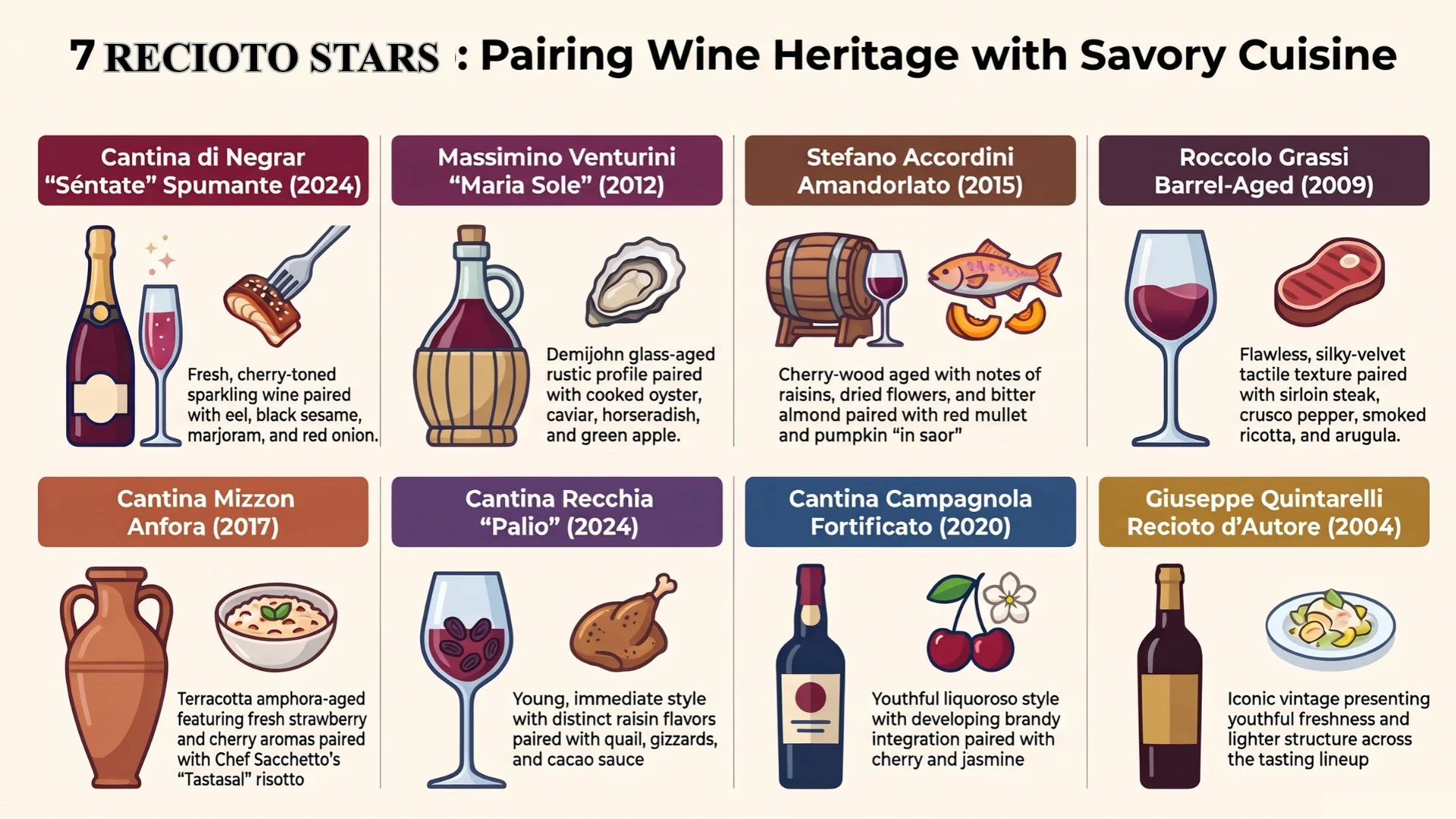
Personally, I’ve always doubted it. Something just didn't add up. A recent wine event hosted at “Iris”, an elegant restaurant in downtown Verona, and organized by the Western chapter of Assoenologi, confirmed many of my doubts. We tasted seven different types of Recioto: that’s how many versions of Recioto were produced in the past, varying in sweetness, alcohol level, and effervescence. Today, only 2 or 3 of them are still produced.
Recioto della Valpolicella is an ancient wine dating back to Roman times, with 2,000 years of history. For centuries, it was regarded as a precious drink offered to the gods, affordable only by emperors, kings, or the ultra-wealthy. It was - and still is - made from native red grapes selected in the vineyard, dried in fruit-drying rooms (fruttai) for over 100 days, and then pressed and fermented until reaching the right balance among sugars, acidity, tannins, and alcohol. If you know a thing or two about winemaking, you’ll understand that this is the crux of the matter: this balance is extremely challenging to achieve.
“To make a great Recioto you need the right site, old vines, a great vintage, and passion, because it is truly a difficult wine to make,” as Marco Sartori (Roccolo Grassi winery) observed. This brings us to the core issue: the high level of expertise required. Nowadays, almost any winery in Valpolicella can make a decent Amarone. However, making a great Recioto is easier said than done. That is where personal passion comes into play; without a genuine love for this wine, a producer will only ever make a competent bottle, never an outstanding one. And today's market demands exactly that top-tier level of quality when it comes to sweet wines.
The second difficulty is cultural. In Italy, sweet wines have traditionally been paired with desserts or served strictly at the end of a meal. In the nineties, some tried pairing sweet wines with aged or flavored cheeses, a challenging pairing in its own right.
If that pairing had been truly successful, everyone would now be drinking Recioto whenever cheese is on the table. That simply isn't the case, and today that pairing is also out of style in many cases.
The third issue comes down to cost: Recioto is expensive to make, sell, and buy. Amarone della Valpolicella is also expensive, but it is so successful that its annual production reaches about 13 million bottles, while Recioto does not even reach half a million. And there is also a fourth drawback: packaging. Bottle sizes and label designs are often unappealing or outdated.
In short, there is a lot of work to be done. Is it worth it? I think so, because the adult beverage landscape is experiencing a clear shift toward flavor-centric, expressive drinks. There is still room for a classic wine like Recioto; consumers still enjoy sweet beverages.
Provided, however, that it no longer appears in public dressed up like an ancient Roman.