
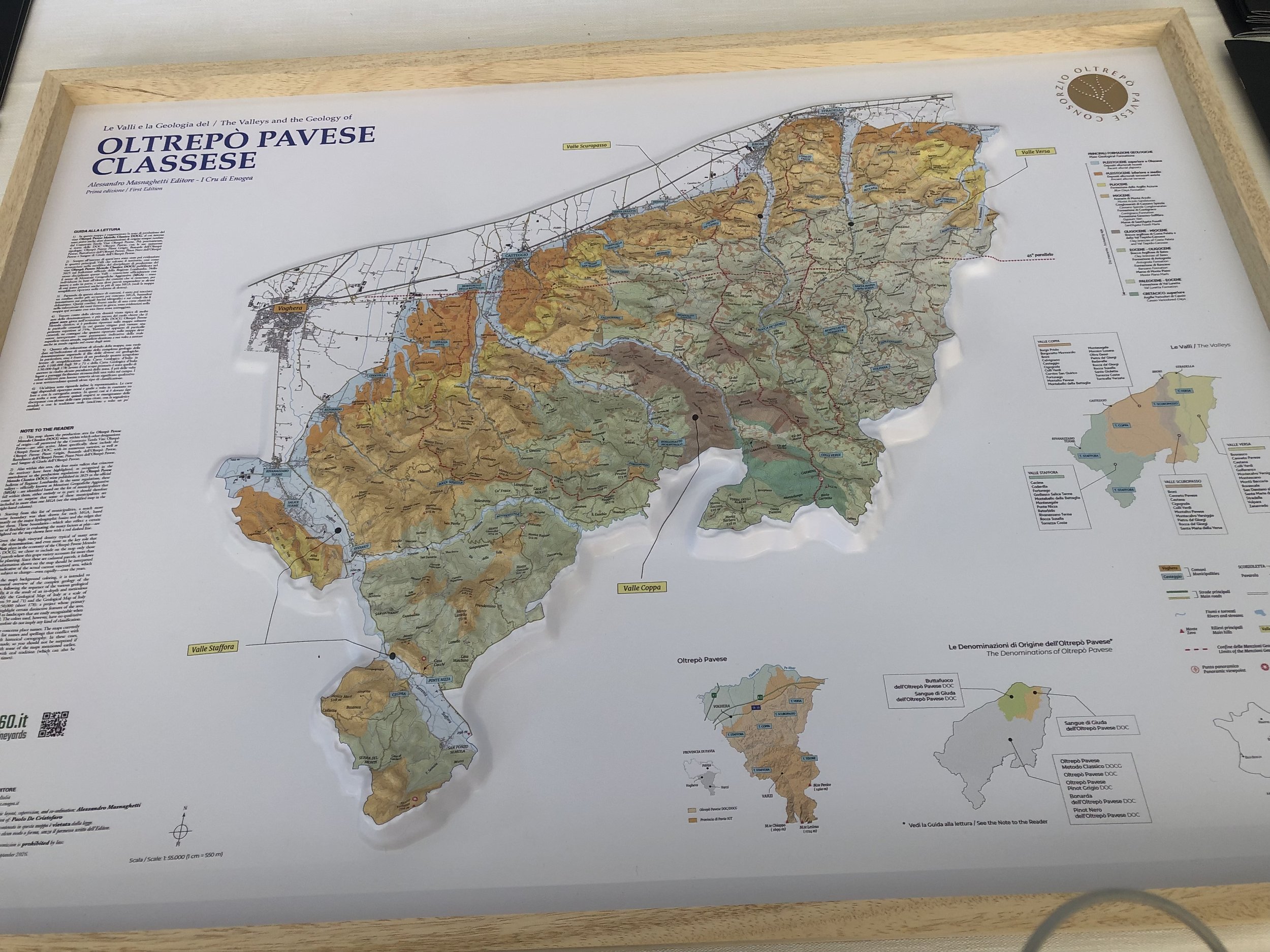
Halfway between Milan and the 45th parallel, Oltrepo Pavese quietly bottles around 25 million wines a year across seven DOCs and DOCGs... yet everything here still comes back to just one grape.
That grape is Pinot Noir, and it makes up roughly 70% of Italy's total plantings. Most people outside Italy don't know that. These hills are the variety's undisputed Italian cradle, and among the country's four Metodo Classico appellations - Franciacorta, Alta Langa, Trento - Oltrepò Pavese is the only one built entirely around Pinot Noir, with a DOCG reserved exclusively for Blanc de Noirs.
The rules are strict, because you need at least 70% Pinot Nero to qualify. Most producers though don't stop there and go all the way to 100%.
The region's cutting back. In its place is now a singular wine that has taken the crown: Classese, the shared mark for Metodo Classico Blanc de Noirs.
Pinot Noir has always been produced here as a still wine, that's nothing new. But the sparkling version goes back to 1865, when Count Augusto Giorgi di Vistarino produced the region's first traditional-method blanc de noirs at Rocca de' Giorgi, tucked into the steep Valle Scuropasso. Nineteenth-century surveys had already noted the calcareous soils' uncanny resemblance to the great terroirs of France.
The name "Classese" is a fusion of Classico (referring to the method) and Pavese; it was coined in 1984 by a group of forward-thinking local producers, but spent decades as a little-known private brand. Under the Consorzio Tutela Vini Oltrepò Pavese, it is now slated to become the official name of the DOCG itself, consolidating 160 years of sparkling tradition into a single global-facing identity. Its relaunch comes with rewritten production rules establishing some of the strictest quality criteria in Italian sparkling wine: manual harvesting, Pinot Noir dominance, extended lees aging, and, for the first time, even Additional Geographic Mentions. These latest recognize the four historic valleys of origin: Valle Versa, Valle Scuropasso, Valle Coppa, and Valle Staffora.
Supporting the reform is the Consorzio's most ambitious project in its 50-year history: a complete viticultural mapping of the region. The author of this (hard) work is Alessandro Masnaghetti, the journalist and wine critic widely regarded as Italy's foremost cartographer of wine zones. His 2D and 3D map set, anchored in Oltrepo's ancient seabed geology and accompanied by a relief map and companion manual, draws on thousands of kilometers of fieldwork and hundreds of local interviews.
"This is not zoning," Masnaghetti told an audience of producers and journalists. "It is an accessible, field-tested guide meant to establish a common language among winemakers, sommeliers, and wine lovers." The map, he argued, connects the visible landscape to the glass, giving (hopefully) Oltrepo Pavese the tools to claim its place among the world's great sparkling regions.